Archive

May 2026

Browsing

Major League Baseball owners made their long-expected salary cap proposal to the players’ association on Thursday, a system the union has vowed never to accept, setting the sides on course for a confrontation that threatens the 2027 season and perhaps beyond.

Baseball owners hadn’t proposed a firm cap since 1994. Their effort prompted a 7 1/2-month strike that forced the cancellation of the World Series for the first time in 90 years.

MLB’s proposal would cap spending in 2027 at $245.3 million, using figures for luxury tax payrolls that include benefits and the pre-arbitration bonus pool, and establish a payroll floor of $171.2 million. The Los Angeles Dodgers, baseball’s biggest spenders, had a $415.2 million payroll on opening day this year — around $170 million over the proposed cap.

Owners said they would discuss a phase-in schedule that would give teams like the Dodgers time to comply with the cap and an escrow system with the union as part of a proposed seven-year deal, that all current contracts would remain guaranteed and there would be no prohibition of guaranteed contracts under the cap system.

MLB said it would centralize local media revenue from the 30 teams equally and give players a 50-50 split as part of a proposal that would eliminate the current revenue-sharing plan among the clubs.

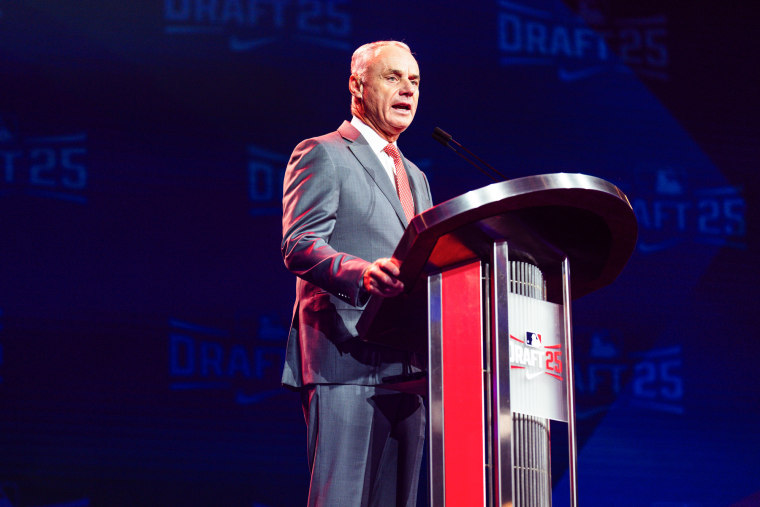
Major League Baseball Commissioner Rob Manfred.Matthew Grimes Jr. / Atlanta Braves via Getty Images file

“Our salary cap and floor proposal levels the playing field while sharing baseball revenue with the players 50/50 as we grow the game together,” MLB spokesman Glen Caplin said in a statement. “Further, by sharing media revenue equally as part of our proposal, we can address another top fan concern of local TV blackouts.”

Baseball’s current five-year deal, agreed to in March 2022 after a 99-day lockout, expires Dec. 2. While a lockout next winter is expected, talks are not likely to intensify until late February or early March 2027, when the possibilities of losing regular-season games and revenue near. If regular-season games are lost, negotiations may become a standoff of which side can tolerate the most economic loss.

Based on 2026 opening day figures, eight teams would have to cut payroll to get under the cap. The teams over are the two-time reigning World Series champion Dodgers, New York Mets ($379.2 million), New York Yankees ($339.6 million), Toronto ($319.5 million), Philadelphia ($315.2 million), Boston ($263.7 million), San Diego ($260.1 million) and Atlanta ($247.9 million).

Twelve teams would be required to increase payroll by a total of $617 million based on 2026 numbers: Miami ($81.8 million), Cleveland ($95.7 million), Tampa Bay ($108.2 million), the Chicago White Sox ($108.6 million), St. Louis ($114.4 million), Washington ($119.1 million), Pittsburgh ($122.6 million), Minnesota ($125.6 million), Milwaukee ($130.9 million), the Athletics ($139.2 million), Colorado ($142.2 million) and Cincinnati ($148.8 million).

Owners and the union agreed to a luxury tax in 2003 designed to slow spending, but teams feel it has had little or no impact on the Dodgers and Mets in recent years. The last small-market MLB club to win a World Series was Kansas City in 2015, although Cleveland, Tampa Bay and Milwaukee all lead their divisions as of Thursday, while the Mets and Red Sox are in last place.

MLB said its revenue has grown by 247% since 2003 and player payroll has increased by 149% in that span.

Management gave the union its latest plan during a bargaining session at the commissioner’s office, one day after the union made its economic proposal. Owners say a cap is needed to improve competitive balance and restrain wealthy teams from assembling starrier rosters than their smaller-market brethren.

Players want expanded free agency and salary arbitration rights along with almost doubling the major league minimum, increasing the money high-revenue teams share with the less-wealthy clubs and establishing penalties for teams that drop below payroll floors.

Aaron Judge of the U.S. leads teammates onto the field before game against Venezuela in the World Series of Baseball in Miami on March 17.Megan Briggs / Getty Images file

Other U.S. major sports leagues operate under a cap. The NBA had a cap in its initial season in 1946-47, then dropped that and began its modern version in 1984-85. NFL players and owners adopted a cap for the 1994 season, and the NHL did so in 2005-06 after a lockout wiped out the entire 2004-05 season.

The Dodgers shattered MLB’s spending record with a combined $515 million in payroll and luxury tax last year en route to their second straight World Series title. Los Angeles’ total was seven times the $68.7 million payroll of the Marlins, the lowest-spending team, and more than the payrolls of the bottom six clubs combined.

Players say a cap would hurt them and enrich owners, and they say they will never agree to one. Without a cap, MLB stars have landed lucrative, guaranteed contracts that outpace what the biggest stars in other U.S. sports leagues make. Juan Soto’s $765 million, 15-year contract with the Mets is believed to be the biggest ever in team sports and is far greater than the largest deals in the NFL (Patrick Mahomes at $450 million over 10 years) and NBA (Jayson Tatum at $314 million over five years).

MLB’s last salary cap proposal in 1994 offered players a 50-50 split of revenue in a system that would have forced teams to maintain payrolls of 84%-110% of the average. Salary arbitration would have been eliminated and the threshold for free agency would have been lowered from six years’ major league service to four — with the provision that a player’s former club could match any offer until he had six years.

MLB’s offer came on June 14 that year, and players struck on Aug. 12. MLB withdrew the cap proposal the following Feb. 6 after pressure by the National Labor Relations Board. The strike ended on March 31 after U.S. District Judge Sonia Sotomayor — now a Supreme Court justice — issued an injunction restoring the work rules of the expired labor contract. Two days later, owners accepted the union’s offer to return to work without an agreement. A deal wasn’t reached until 1997.
For years, California Gov. Gavin Newsom has reaped the benefits of Silicon Valley’s AI boom — in the form of tax revenue for his state and political contributions from industry leaders.

Newsom’s interests often aligned with those of tech titans, and he largely protected those interests. In 2024, for example, he vetoed a bill that would have created legal liabilities for artificial intelligence companies in the event of catastrophes involving terrorism, mass casualties or other damage to society. It would also have required the companies to maintain kill switches so that AI processes could be turned off.

Newsom has long talked about the need to find a practical balance between utopian corporate visions of AI’s upsides and dystopian populist nightmares of human subservience to machines.

“Given the stakes — protecting against actual threats without unnecessarily thwarting the promise of this technology to advance the public good — we must get this right,” he said in his veto message.

But as he lays the groundwork for a widely anticipated 2028 presidential bid, Newsom is shifting his weight away from the corporate end of the balance and toward the populist end. The move could have implications not only for the Democratic nomination fight, but also in a general election, as the political left and right have coalesced around concerns about AI driving up costs to consumers and posing threats to liberty, cybersecurity and physical safety.

The issue has bedeviled elected officials in both parties at the federal and state levels.

They are clearly feeling heat from the public over a wide variety of AI-related issues, from potential job losses, the expensive energy demands of data centers and sexual exploitation, to more abstract fears of Americans’ lives being run by a handful of the rich and powerful through the use of advanced machines.

On the other side, tech giants bring in money — and spend lavishly on campaigns — and national security experts warn that unilateral disarmament in the AI arms race is a recipe for disaster.

Last week, President Donald Trump scuttled his own planned executive order on AI regulation at the last minute, citing concerns that it might “get in the way” of the country’s ability to compete with China.

At the same time, Newsom is using his power as California’s chief executive to begin rolling out initiatives to beef up AI controls.

Jason Elliott, a policy-minded political consultant who served as Newsom’s deputy chief of staff, said the governor has had his hands deep in AI policy, whether it’s the frontier-safety law he backed last year — which requires major AI developers to identify and mitigate risks before deploying their products — or the legislation he vetoed the year before.

“Just because you can name a problem and take a problem very seriously doesn’t mean that every single solution someone proposes is proper,” Elliott said. “I have never seen an issue move as quickly as AI, and it’s not even close. So every elected official’s position naturally should be evolving on AI from week to week and month to month, because the underlying technology itself seems to change every day.”

Newsom is evolving in real time, to the delight of some progressives who believed he was dragging his feet on behalf of corporations and donors.

Last week, Newsom signed an executive order requiring state agencies to work with industry groups, academics and organized labor to develop plans for assessing and offsetting AI’s effects on California workers.

“The whole system has to be reimagined, and we’re not — I don’t think we’re having an accelerated or advanced conversation right now; we’re still discussing who’s going to pay for my increased electricity because of the data center, which is a legit issue,” Newsom said at a May 19 conference convened by the liberal think tank Center for American Progress in Washington. “But it’s not the issue, and … the tech genie is not going to go back in the bottle.”

Newsom also submitted a revised state budget proposal this month that would vastly increase antitrust enforcement dollars, which have been used to go after companies that use algorithms to set prices.

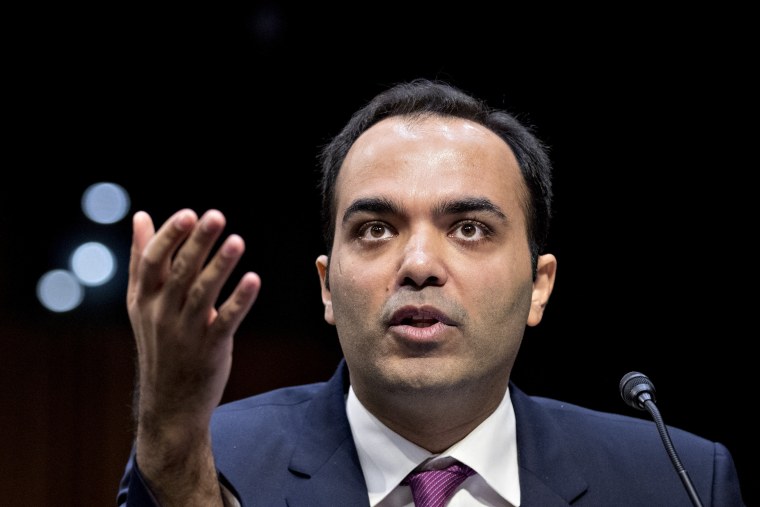
Former Consumer Financial Protection Bureau chief Rohit Chopra.Andrew Harrer / Bloomberg via Getty Images file

Earlier this month, he hired former Consumer Financial Protection Bureau chief Rohit Chopra, who has warned about potential excesses of AI, to head up a state business and consumer services agency. And, along with other prospective 2028 candidates, according to Axios, Newsom has been cozying up to Sen. Elizabeth Warren, D-Mass., who is among the loudest critics of AI’s economic implications.

Among the large crop of prospective 2028 hopefuls, there is a broad spectrum of views on AI and its various uses — and some uncertainty about when and how to regulate them. Data centers, which represent just a slice of AI policy, have become a flashpoint for voters and an area of attention for policymakers with White House ambitions.

Pennsylvania Gov. Josh Shapiro, for example, is tying accelerated permits for data centers to companies’ willingness to pay for power, provide workforce protections and conserve the environment. Rep. Alexandria Ocasio-Cortez, D-N.Y., has called for a moratorium on data centers and pressed federal officials on their impact on drinking water.

Like Newsom, Illinois Gov. JB Pritzker, who is also widely considered to be looking at a 2028 bid, is moving to demonstrate a more cautious approach to AI. In February, he proposed a two-year pause on tax incentives for building data centers.

A YouGov/Economist poll this month found that 71% of Americans — 77% of Democrats and 68% of Republicans — say AI development is “moving too fast.”

“It should be clear to anyone paying attention to polling or even just vibes that there is a lot of voter-level concern about AI and costs and who the economy is serving and who the economy isn’t serving,” Dan Geldon, a former top aide to Warren, said. “It makes sense that Newsom and other candidates would open channels with populists and consider their ideas in this environment.”

But revenue from “hyperscalers” — tech companies that build data centers to handle massive amounts of information — is attractive to many state executives in both parties.

“We’re looking at literally hundreds of millions of dollars annually to local government, cities, counties and school districts that the hyperscaler is going to pay in their fee and loop payments,” Mississippi Gov. Tate Reeves, a Republican who has welcomed data center investments from Amazon, xAI and other major players into his state, said in a recent interview.

And yet there are Republican governors who have taken a much more skeptical view of AI and of data centers.

Florida Gov. Ron DeSantis, a Republican, has pushed unsuccessfully to enact an AI “bill of rights” that would protect data privacy and prevent insurance companies from judging claims based on machine-dictated decisions. Like Reeves, he signed a law requiring hyperscalers to pay utility costs associated with their work.

For 2028 hopefuls in both parties, the opportunities and risks of developing AI policies at machine-learning speed are becoming more clear. For Newsom, there’s been a perceptible shift toward the populist leanings of the progressive wing of his party.

Elliott, his former aide, said it makes sense on a public policy level for the governor to keep up with changes in technology and adjust his response accordingly.

“It’s true that Gov. Newsom has continued to observe the state of the industry, the state of technology, and then update his perspectives as the industry moved forward,” Elliott said. “Republicans are doing the same thing and should be doing the same thing and there are a number of Republicans around the country who are taking the very hands-on approach to regulating artificial intelligence.”

CBS News has reportedly declined to renew its contract with Sharyn Alfonsi, the “60 Minutes” correspondent whose segment about the Trump administration deporting Venezuelan men to a prison in El Salvador was abruptly pulled off the air late last year.

Alfonsi confirmed the expiration of her CBS News deal in an interview with The New York Times published Wednesday. CBS News and Alfonsi did not immediately respond to NBC News’ requests for comment on the matter.

“It sends a chilling message to the entire newsroom,” Alfonsi told the Times. “I think it was a deliberate choice to penalize a journalist for refusing to sanitize accurate reporting.”

“60 Minutes” ultimately aired Alfonsi’s segment in January after a last-minute postponement in late December that the correspondent had claimed was “not an editorial decision” but “a political one.”

The segment featured interviews with men who were deported from the U.S. to the Center for the Confinement of Terrorism, or CECOT, in Tecoluca, El Salvador. The interviewees described torture and physical and sexual abuse at the complex.

In an editorial call Dec. 22, the morning after “Inside CECOT” was pulled from the “60 Minutes” lineup, CBS News Editor-in-Chief Bari Weiss said she had held the story “because it was not ready,” according to a source.

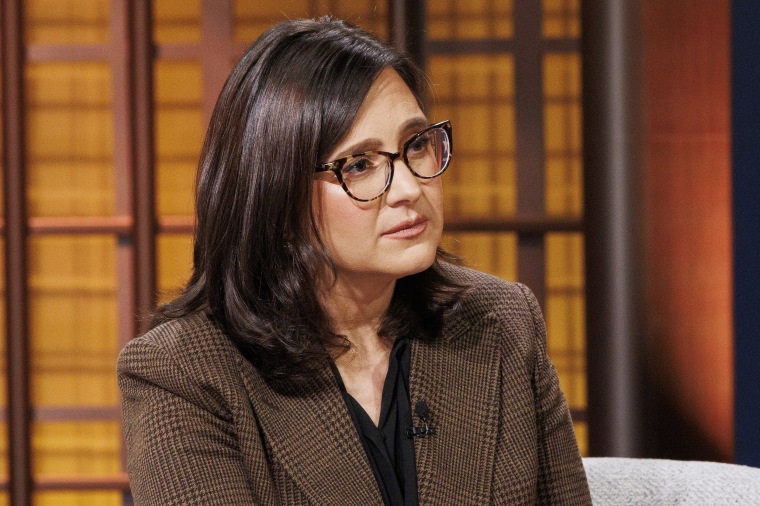
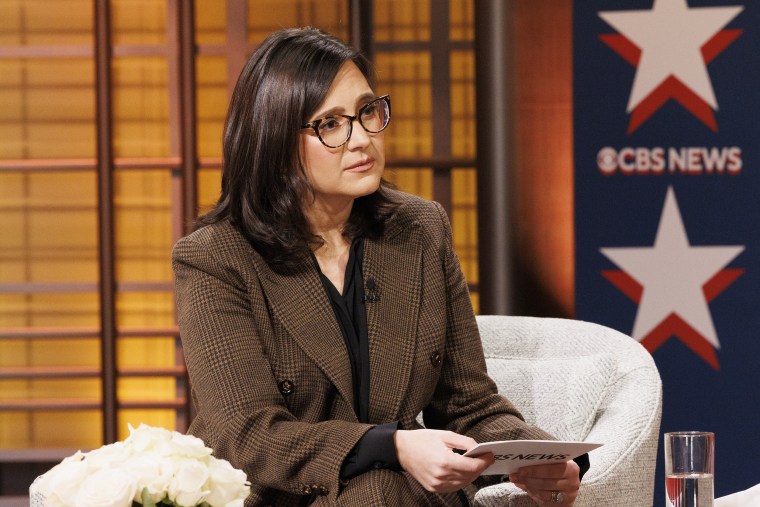
CBS News Editor-in-Chief Bari Weiss moderates a town hall with Erika Kirk on Dec. 10.CBS via Getty Images file

“While the story presented powerful testimony of torture at CECOT, it did not advance the ball — the Times and other outlets have previously done similar work,” Weiss told CBS News staffers, according to that source.

Weiss is a former opinion writer and editor at the Times who launched the website The Free Press in 2021. Paramount Skydance, which owns CBS, acquired The Free Press and hired Weiss as editor-in-chief of CBS News in October.

Alfonsi, who made her “60 Minutes” debut in 2015, continued to appear on the newsmagazine through the end of its 58th season, which concluded May 17.

She is the second “60 Minutes” correspondent to exit the show since Weiss became top editor at CBS News, following Anderson Cooper, who signed off this month after 20 years on the broadcast.

In a farewell message that aired this month, Cooper said in part: “The independence of ‘60 Minutes’ has been critical, and I think the trust it has with viewers is critical to the success of ‘60 Minutes.’”

MIAMI — A federal judge on Wednesday declined to jail a Florida teenager accused of killing and sexually assaulting his stepsister, allowing him to remain in the custody of a family member while he awaits trial.

Timothy Hudson, 16, has been free since the slaying of Anna Kepner, who died on Nov. 7, 2025, aboard a Carnival cruise ship. At the time he was arrested and charged as a juvenile and allowed to live with an uncle because of his age. But in April a federal grand jury indicted him as an adult, introducing the possibility that he could be jailed as he awaits trial.

“If it were a 20-year-old under the exact circumstances I probably would have detained,” U.S. District Judge Edwin Torres said. “The presumption would be we were just not going to take that chance.”

“This is a different animal,” Torres said.

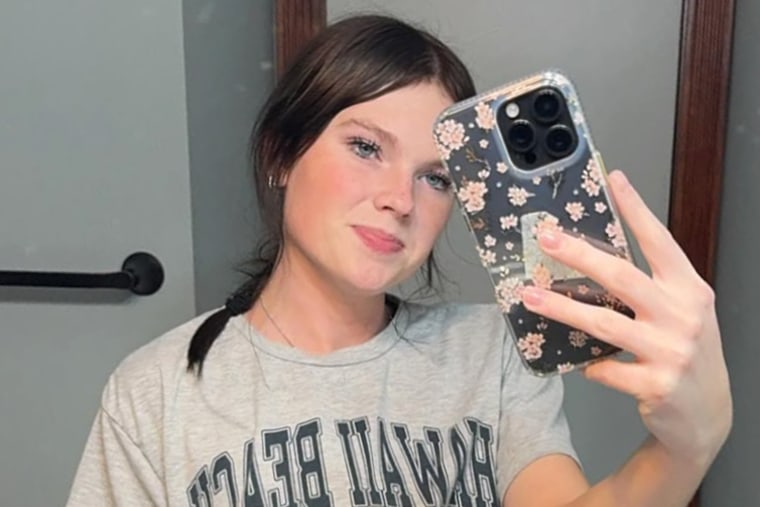
Anna Kepner.anna.kepner16 via Instagram

Torres took into consideration that detaining Hudson in Miami-Dade County — where he was charged — would make it difficult for his family, which lives hundreds of miles away in Hernando County, to visit him.

The judge said he wanted to “know what my options are” about potentially detaining Hudson closer to home before deciding to hold him behind bars.

Alejandra Lopez, a lawyer for the government, argued that Hudson is “a danger to the community” and questioned how authorities can trust “this defendant won’t act again.”

She noted that two minors live in Hudson’s uncle’s home, where he is residing.

“What is needed to prove a danger? A second dead body?” she asked.

Evan Kuhl, a public defender representing Hudson, argued that his client is not a danger to the public or a flight risk because he has abided by the conditions of his release for several months without any incidents.

Lopez shot back that it took months after Kepner’s death for officials to charge Hudson because authorities were gathering evidence.

“How is he going to be a risk of flight if he doesn’t even know if he’s going to be charged?” she asked. “That doesn’t make sense.”

Hudson is only allowed to leave his house with his uncle or aunt and will be electronically monitored by authorities.

Anna Kepner’s car, decorated by her classmates at Temple Christian School, remained in the school parking lot in Titusville, Fla., for weeks after her death. Malcolm Denemark / USA Today Network via Imagn

The November cruise vacation included the victim’s father, stepmother and two of her children, including Hudson. Kepner’s father and Hudson’s mother married in December 2024.

Kepner’s body was found wrapped in a blanket, bruised and under a bed in her room, concealed by life vests. Her death was ruled a homicide caused by “mechanical asphyxiation,” according to the Miami-Dade medical examiner.

The girl and her stepbrother were sharing a room on the cruise, according to Hudson’s father’s lawyer.

The teenager was arrested while the ship was in international waters en route to Miami. He was hospitalized upon the ship’s docking and has since been in counseling, according to a lawyer for his mother.

On the day Hudson’s indictment was made public, Chris Kepner — Anna Kepner’s father and Hudson’s stepfather — declared that “justice needs to be served.”

Kepner was a high school senior and cheerleader, with hopes of cheerleading for the University of Georgia. She was remembered in her obituary for lacking a filter and being “bubbly, funny, outgoing, and completely herself.” At the time, her family said that “in true Anna fashion, the family would like everyone to know there is no GoFundMe” for her funeral. She was set to graduate from high school this spring.

Hudson’s trial could begin in September, Lopez said Wednesday.

CBS News editor-in-chief Bari Weiss on Thursday replaced Tanya Simon, the executive producer of the network’s flagship newsmagazine “60 Minutes,” with a technology journalist who has never worked in television news.

Nick Bilton, a documentarian and former New York Times technology columnist, will take over for Simon when the show returns for a 59th season in the fall, CBS News leaders announced.

The moves are part of Weiss’ sweeping shake-up of the storied program, created by the legendary producer Don Hewitt.

CBS News has also cut ties with “60 Minutes” correspondent Cecilia Vega, who joined the show in 2023, according to a source familiar with the matter.

Sharyn Alfonsi, another “60 Minutes” correspondent, told the Times this week that CBS News had not renewed her contract. CBS News and Alfonsi did not respond to multiple requests for comment on the status of her deal.

Alfonsi clashed with Weiss late last year over the last-minute postponement of her segment about the Trump administration deporting Venezuelan men to a notorious prison in El Salvador.

Alfonsi said the delay was “not an editorial decision” but a “political one.” Weiss said she held the story “because it was not ready.” It ultimately aired in January.

Weiss — who also had no TV news experience when she was hired last fall — said in a statement that Bilton was “one of the most entrepreneurial journalists of our time and the perfect leader for one of the most entrepreneurial news brands of all time.”

Bari Weiss, CBS News’ editor-in-chief.Michele Crowe / CBS via Getty Images file

“We have huge ambition for ‘60 Minutes’ to reach new heights through deep, revelatory journalism that breaks news, exposes wrongdoing, widens public understanding and forces accountability from every institution and every center of power,” Weiss added.

In a letter to “60 Minutes” staff Thursday, Bilton introduced himself and said in part: “I’m here to lead this show, not preserve it under glass. That means honoring what works and being honest about what doesn’t. I have a notebook full of ideas.”

“Some are about the show itself. Some are about the next generation of correspondents. Some are about the strange fact that we produce one extraordinary hour for one night a week in a world that consumes content around the clock,” he added.

In a statement shared with NBC News, Simon acknowledged that “leadership has decided it is time for a new chapter.”

“I want to be unequivocally clear about one thing: it has been an immense privilege to lead this broadcast, and I could not be prouder of what we have built, fought for, and delivered together over the last year,” Simon added.

“60 Minutes” has faced intense criticism from President Donald Trump, who sued CBS before the 2024 election over an interview with former Vice President Kamala Harris that he claimed had been deceptively edited. CBS vehemently denied that claim. Paramount eventually settled the suit for $16 million.

Bilton’s reporting has appeared in the Times and Vanity Fair. In recent years, Bilton produced documentaries about business and technology for Netflix and HBO, including a film about disgraced Theranos founder Elizabeth Holmes.

Weiss is a former opinion writer and editor at the Times who launched the website The Free Press in 2021. Paramount Skydance, which owns CBS, acquired The Free Press when it hired her.

She has overseen a wave of big-picture changes at CBS News since she was hired in October, including tapping Tony Dokoupil as anchor of “CBS Evening News.”

The departures of Vega and Alfonsi came after CNN primetime anchor Anderson Cooper announced he was leaving the series following a 20-year run as a correspondent.

In a farewell message this month, Cooper said in part: “The independence of ‘60 Minutes’ has been critical, and I think the trust it has with viewers is critical to the success of ‘60 Minutes.’”

Markets don’t usually hit record highs, risk falling into bearish territory, and spring back to new highs within six months. But that’s what happened in 2025.

In this special mid-year recap, Grayson Roze sits down with David Keller, CMT, to show how disciplined routines, price-based signals, and a calm process helped them ride the whipsaw instead of getting tossed by it. You’ll see what really happened under the surface, how investor psychology drove the swings, and the exact StockCharts tools they leaned on to stay objective. 

If you’re focused on protecting capital, generating income, and sleeping well at night while still capturing the upside, this is a must-watch. Discover which charts deserve your attention now, what to ignore, and how to prep for the back half of 2025. 

This video premiered on July 23, 2025. Click on the above image to watch on our dedicated Grayson Roze page on StockCharts TV.

You can view previously recorded videos from Grayson at this link.

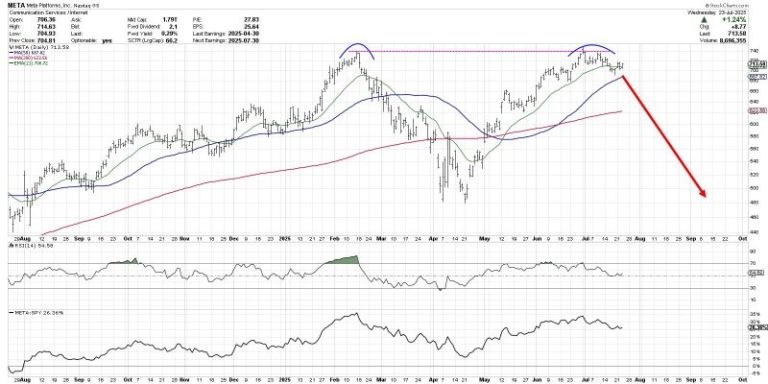
The chart of Meta Platforms, Inc. (META) has completed a roundtrip from the February high around $740 to the April low at $480 and all the way back again.  Over the last couple weeks, META has now pulled back from its retest of all-time highs, leaving investors to wonder what may come next.

Is this the beginning of a new downtrend phase for META?  Or just a brief pullback before a new uptrend phase propels META to new all-time highs?

Today we’ll look at two potential scenarios, including the double top pattern and the cup and handle pattern, and share which technical indicators and approaches could help us determine which path plays out into August.

The double top scenario basically means that the late July retest of the previous all-time high was the end of the recent uptrend phase.  The double top pattern is literally when a major resistance level is set and then retested.  The implication is that a lack of willing buyers means the uptrend is exhausted, and there is nowhere to go but down.

While the 21-day exponential moving average is currently in play for META, I would say that a break below the 50-day moving average could confirm this as the correct scenario.  If that smoothing mechanism does not hold, then the price action would imply less of a pullback and more like the beginning of a real distribution phase.

What is META pulls back but then resumes an uptrend phase, leading META to another new all-time high?  That would result in a confirmed cup and handle pattern, created by a large rounded bottoming pattern followed by a brief pullback.  The key to this pattern is the “rim” of the cup, which sits right at $740 for META.

Given the pullback META has demonstrated so far in July, I would say that a break above the $740 level would basically confirm a bullish cup and handle pattern.  That would suggest much more upside potential for META, as the stock would literally go into previously uncharted territory.

So how can we determine which scenario is more likely to play out?  This is where we need to incorporate more technical indicators into the discussion, as a way to further validate and confirm our investment thesis.

Just to review, I think a break above $740 would confirm a bullish cup and handle pattern.  I would also say that a break below the $680 level, which would represent a move below the 50-day moving average as well as the June swing lows, would basically confirm a bearish double top pattern.

We can also use the Relative Strength Index (RSI) to help determine whether META remains in a bullish trend phase.  During bull phases, the RSI rarely gets below 40, because buyers usually step in to “buy the dips” and keep the momentum fairly constructive.  So if the price would break down, and the RSI would not hold that crucial 40 level, that could mean a bearish outlook is warranted.

Finally, we can use volume-based indicators to assess whether moves in the price are supported by stronger volume readings.  Here I’ve included the Accumulation/Distribution Line, which tracks the trend in daily volume readings over time.  We can see that the high in July resulted in a divergence, as the A/D line was trending lower.  If the A/D line would break below its June and July lows, marked by a dashed red line, that would represent a bearish volume reading for META.

Technical analysis is less about predicting the future, and more about determining the most probable scenarios based on our analysis of trend, momentum, and volume.  I hope this discussion shows how the outlook for META can be easily determined and tracked using the best practices of technical analysis!

RR#6,

Dave

PS- Ready to upgrade your investment process?  Check out my free behavioral investing course!

David Keller, CMT

President and Chief Strategist

Sierra Alpha Research LLC

marketmisbehavior.com

https://www.youtube.com/c/MarketMisbehavior

Disclaimer: This blog is for educational purposes only and should not be construed as financial advice.  The ideas and strategies should never be used without first assessing your own personal and financial situation, or without consulting a financial professional.  

The author does not have a position in mentioned securities at the time of publication.    Any opinions expressed herein are solely those of the author and do not in any way represent the views or opinions of any other person or entity.

Is the market’s next surge already underway? Find out with Tom Bowley’s breakdown of where the money is flowing now and how you can get in front of it.

In this video, Tom covers key moves in the major indexes, revealing strength in transports, small caps, and home construction. He identifies industry rotation signals, which are pointing to aluminum, recreational products, and furnishings. Tom then demonstrates how to use StockCharts’ tools to scan for momentum stocks in emerging leadership groups — see why SGI tops Tom’s list. He ends with a discussion of post-earnings reactions from major names like GOOGL, TSLA, IBM, and LVS. 

And, of course, Tom wraps every idea with clear chart setups you can act on today. 

This video premiered on July 24, 2025. Click this link to watch on Tom’s dedicated page.

Missed a session? Archived videos from Tom are available at this link.

The S&P 500 ($SPX) just logged its fifth straight trading box breakout, which means that, of the five trading ranges the index has experienced since the April lows, all have been resolved to the upside.

How much longer can this last? That’s been the biggest question since the massive April 9 rally. Instead of assuming the market is due to roll over, it’s been more productive to track price action and watch for potential changes along the way. So far, drawdowns have been minimal, and breakouts keep occurring. Nothing in the price action hints at a lasting change — yet.

While some are calling this rally “historic,” we have a recent precedent. Recall that from late 2023 through early 2024, the index had a strong start and gave way to a consistent, steady trend.

From late October 2023 through March 2024, the S&P 500 logged seven consecutive trading box breakouts. That streak finally paused with a pullback from late March to early April, which, as we now know, was only a temporary hiccup. Once the bid returned, the S&P 500 went right back to carving new boxes and climbing higher.

New 52-Week Highs Finally Picking Up

If there’s been one gripe about this rally, it’s that the number of new highs within the index has lagged. As we’ve discussed before, among all the internal breadth indicators available, new highs almost always lag — that’s normal. What we really want to see is whether the number of new highs begins to exceed prior peaks as the market continues to rise, which it has, as shown by the blue line in the chart below.

As of Wednesday’s close, 100 S&P 500 stocks were either at new 52-week highs or within 3% of them. That’s a strong base. We expect this number to continue rising as the market climbs, especially if positive earnings reactions persist across sectors.

Even when we get that first day with 100+ S&P 500 stocks making new 52-week highs, though, it might not be the best time to initiate new longs.

The above chart shows that much needs to align for that many stocks to peak in unison, which has historically led to at least a short-term consolidation, if not deeper pullbacks — as highlighted in yellow. Every time is different, of course, but this is something to keep an eye on in the coming weeks.

Trend Check: GoNoGo Still “Go”

The GoNoGo Trend remains in bullish mode, with the recent countertrend signals having yet to trigger a greater pullback.

Active Bullish Patterns

We still have two live bullish upside targets of 6,555 and 6,745, which could be with us for a while going forward. For the S&P 500 to get there, it will need to form new, smaller versions of the trading boxes.

Failed Bearish Patterns

In the chart below, you can view a rising wedge pattern on the recent price action, the third since April. The prior two wedges broke down briefly and did not lead to a major downturn. The largest pullbacks in each case occurred after the S&P 500 dipped below the lower trendline of the pattern.

The deepest drawdown so far is 3.5%, which is not exactly a game-changer. Without downside follow-through, a classic bearish pattern simply can’t be formed, let alone be broken down from.

We’ll continue to monitor these formations as they develop because, at some point, that will change.

Here are some charts that reflect our areas of focus this week at


XLU Leads with New High

Even though the Utilities SPDR (XLU) cannot keep pace with the Technology SPDR (XLK) and Communication Services SPDR (XLC), it is in a leading uptrend. XLU formed a cup-with-handle from November to July and broke to new highs the last two weeks. ETFs hitting new highs are in strong uptrends and should be on our radar.


Metal Mania in 2025

In a tribute to Ozzy, metals are leading the way higher in 2025. The PerfChart below shows year-to-date performance for the continuous futures for 12 commodities. Copper, Platinum and Palladium are up more than 45% year-to-date, while Gold is up 28.38% and Silver is up 35.30%. QQQ is up 10.52% year-to-date, but lagging these metals. The other commodities are mixed.


Multi-Year Highs for Silver and Copper

The next chart shows 11 year bar charts for five metals. Gold broke out in early 2024 and led the metals move with an advance the last 21 months. Silver and copper broke out to multi-year highs. Platinum broke above its 2021 high and Palladium got in the action with an 18 month high. There is a clear message here: metals are moving higher and leading as a group.  


Home Construction Hits Moment of Truth

The Home Construction ETF (ITB) hit its moment of truth as it rose to its falling 40-week SMA. Notice that ITB failed just below this moving average in August 2023. During the 2023-2024 uptrend, the 40-week SMA was more friendly as ITB reversed near this level in October 2023 and June 2024. ITB surged to the falling 40-week SMA in July, but the long-term trend is down and this area could be its nemesis.

Thanks for Tuning in!

See TrendInvestorPro.com for more